
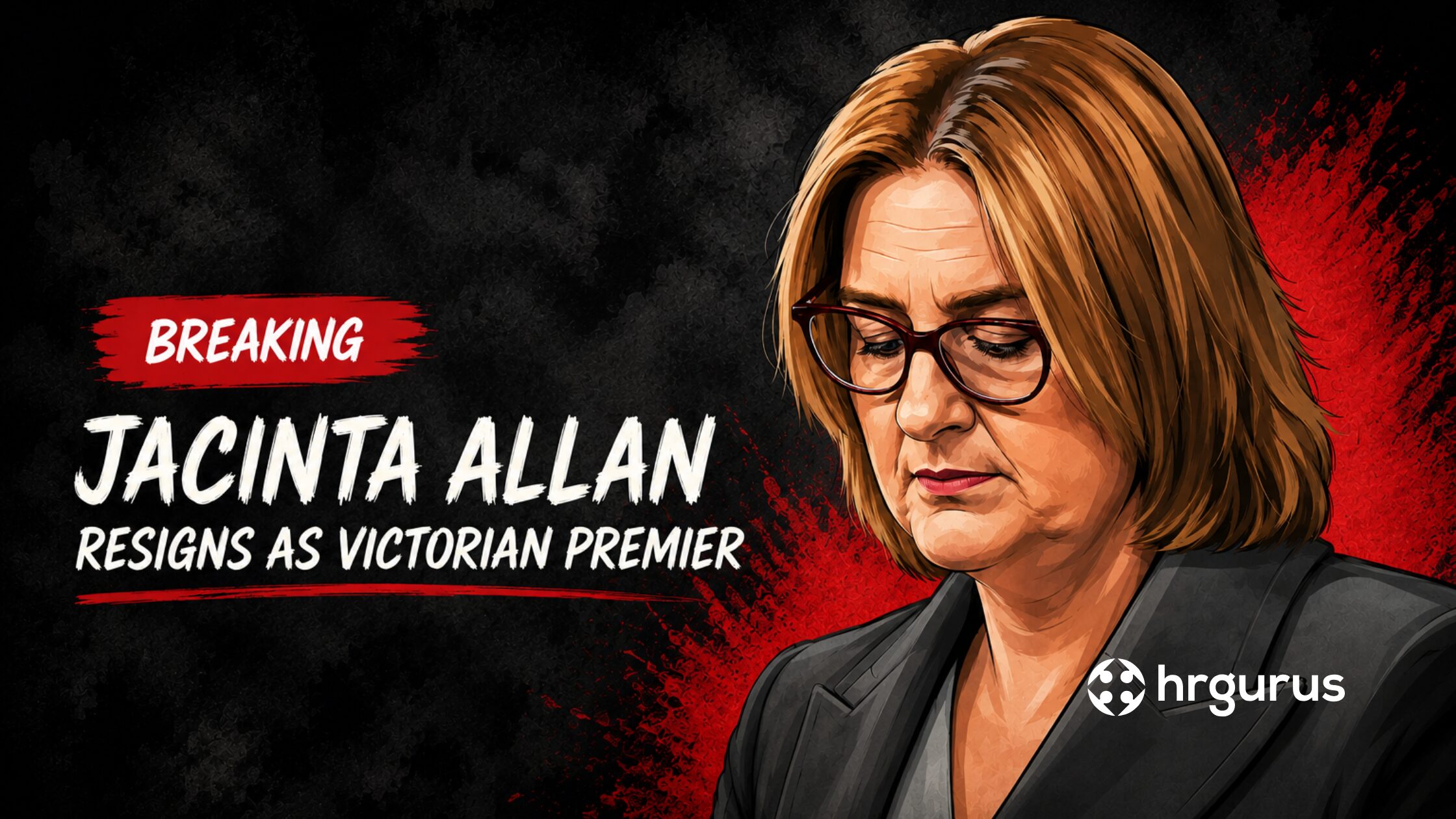
Jacinta Allan quit as Victorian Premier on Tuesday morning, hours before a party room spill that would have removed her anyway. Deputy Premier Ben Carroll is set to take over unopposed, four months out from a state election Labor is currently on track to lose.
If you run a small business in Victoria, the leadership change itself isn’t the story. The story is what got us here, and what it tells you about the next four months of political noise you’re going to have to run your business through.
Why Did Jacinta Allan Resign?
Allan never won an election as leader. She took the top job in September 2023 when Daniel Andrews resigned, inheriting both the premiership and everything that came with it, without ever having to put herself to voters first.
That distinction matters now. Newspoll figures had Labor trailing the Coalition 48 to 52 on a two-party-preferred basis, with One Nation’s primary vote climbing. Voters are frustrated with the cost of living, rising state debt and infrastructure delays, and Labor’s own MPs decided an unelected leader with collapsing polling wasn’t someone they could take to a November election.
Announcing his leadership bid, Carroll put it plainly: the risk of a Liberal-One Nation government was too high to ignore. Translation: this was never about Allan’s performance in the abstract. It was about whether Labor could win with her name on the ballot. When she couldn’t guarantee that, the party moved.
What About Her ‘Achievements’ on the Way Out?
Allan framed her exit as putting the party and the state first. That’s the standard line for any resignation under pressure, and it’s worth reading against what she leaves behind rather than what she says about it.
The centrepiece of her record, and Andrews’ before her, is the Big Build: the largest infrastructure programme in the state’s history, covering the Metro Tunnel, the Suburban Rail Loop, the West Gate Tunnel and dozens of road and hospital projects. It was meant to be the government’s legacy. Instead it’s become the subject of the state’s most serious corruption allegations in decades.
The Big Build Numbers Victorian Taxpayers Are Actually Wearing
An independent investigation led by barrister Geoffrey Watson KC, run through a Queensland inquiry into construction industry misconduct, put potential losses to CFMEU-linked corruption and organised crime infiltration at up to $15 billion. That’s not a fringe claim. Fair Work Commission figures and industry sources cited cost blowouts of 10 to 30 per cent on Big Build projects, driven by union standover tactics, inflated subcontracting and so-called “ghost shifts”, labour hire companies billing for work that was never done.
Allan has disputed the $15 billion figure and rejected calls for a royal commission, instead pointing to reforms since the CFMEU was placed into federal administration in 2024. But she has also personally apologised, admitting criminals infiltrated some of the state’s largest construction projects. Separate reporting has alleged she approved an $837 million payment based on CFMEU demands, and that as transport minister in 2022 she pressured a department to engage a labour hire company later found to be corrupt, at a cost of an extra $2 million to taxpayers. She has denied wrongdoing on that specific allegation.
Whatever version you believe, the pattern is consistent: warnings were raised, costs kept climbing, and the response for years was to defend the programme rather than open it up to scrutiny with real powers behind it. A royal commission has coercive powers a standard government review doesn’t. Refusing one, while the allegations keep mounting, is a choice.
The Debt Bill: What Labor Inherited vs What It’s Leaving Behind
The Big Build didn’t happen in a vacuum. It was funded by debt, and the numbers on that are stark.
When Labor took office under Daniel Andrews in November 2014, Victoria’s net debt sat at roughly $20 billion, one of the most fiscally conservative positions of any Australian state at the time. By June 2023, in Andrews’ final year, that figure had ballooned to almost $117 billion, more than five times what Labor inherited. In his last budget before quitting politics, Andrews projected debt would keep climbing to $171 billion within four years.
Allan picked up where he left off. Net debt now sits at $165.3 billion as at June 2026, forecast to hit $175.6 billion by June 2027 and $199.3 billion by 2029-30. Since 2014, Victoria’s debt has grown by roughly 415 per cent, while the state’s economy has grown by only around 29 per cent over the same period. Debt is being taken on at a rate more than fourteen times faster than the economy generating the income to pay for it.
The consequences aren’t abstract. Victoria now carries the lowest credit rating of any Australian state, AA, which pushes up the cost of every dollar the government borrows. Interest alone will cost close to $9 billion this financial year, rising to $11.8 billion, more than $32 million a day, by 2030. There is no stated date by which this debt gets paid off. The government’s own budget papers show it climbing every year through the end of the decade, surplus or no surplus, because operating surpluses don’t account for the billions still being borrowed for capital works.
A decade of a government telling Victorians it’s managing the state’s finances responsibly, while debt grows five times faster than the economy underneath it, is not a record you get to spin your way out of on the way out the door.
The Tax and Red Tape Bill Sent to Business Owners
Someone has to pay for that debt, and the government has been explicit that it’s businesses and property owners picking up a large share of the bill. Here’s what’s actually landed since 2023:
- COVID Debt Levy on land tax: from 2024, the tax-free threshold dropped from $300,000 to $50,000, dragging an estimated 360,000 to 380,000 landowners into land tax for the first time, on top of a flat surcharge of $500 to $975 and a rate increase for holdings over $300,000. Runs until 2033.
- COVID Debt Levy on payroll tax: an extra 0.5 per cent for businesses with national payrolls over $10 million, and another 0.5 per cent on top of that for payrolls over $100 million. Also runs until 2033.
- Mental Health and Wellbeing Levy: a separate payroll tax surcharge running since January 2022, stacking on top of the above for larger employers.
- Absentee owner surcharge: doubled from 2 per cent to 4 per cent of site value from 2024.
- Short Stay Levy: a new 7.5 per cent tax on short-term rental bookings from January 2025, plus owners corporations can now vote to ban listings outright.
- Commercial and industrial property tax reform: stamp duty is being phased out on commercial and industrial property, but replaced with an ongoing annual property tax. It’s a shift in when you pay, not a lighter bill overall.
- Removal of payroll tax exemptions for around 110 high-fee private schools.
If you own the building your business operates from, there’s a good chance you’re now paying land tax you weren’t paying three years ago. If you employ people, there’s a good chance payroll tax has crept up too, regardless of what your actual profitability looks like. None of this is conspiracy or spin. It’s in the government’s own budget papers, introduced specifically to repay debt the government itself ran up.
On Top of the Bill, More Red Tape
Alongside the tax increases, business owners are also absorbing new compliance obligations. The Equal Opportunity Amendment (Work from Home) Bill 2026 will give eligible employees a statutory right, not just a right to request, to work from home two days a week from 1 September 2026, with a delayed start of 1 July 2027 for businesses under 15 staff. Employers will be required to cover reasonable costs of the arrangement, and disputes go to the Victorian Equal Opportunity and Human Rights Commission or VCAT, not a conversation with your HR adviser first. New restrictions on the use of NDAs in workplace sexual harassment matters also came into effect from July 2026.
Each of these changes might be defensible on its own. Stacked together, in the space of about three years, on top of a decade of tax rises to repay debt that’s still growing, it adds up to a genuine cost and compliance load that Victorian business owners are wearing, whether they had a say in it or not.
What About Crime? Checking the Premier’s Claim Against the Numbers
The government’s most recent line is that crime is going down. That claim needs a closer look before anyone repeats it.
It’s true that the year to March 2026 showed a small drop, offences down 0.2 per cent and the criminal incident rate down close to 3 per cent, the first decrease Victoria has recorded in almost four years. But the same Crime Statistics Agency release makes clear that overall crime is still up 26 per cent over the past three years. Just three months earlier, the year to December 2025 recorded criminal incidents at their highest level since the agency started collecting data in 2004-05. Car theft alone hit 31,851 vehicles last year, the highest figure since 2001-02 and more than double what it was four years earlier.
So the claim that crime is going down is technically accurate for the single most recent data point, and badly misleading as a description of the trend. One slightly better quarter after nearly four years of sharp increases doesn’t undo the underlying picture, and Victoria Police’s own analysis says it will take considerable time before crime returns to levels the state has traditionally seen. Business owners dealing with break-ins, retail theft or vehicle theft don’t need a press release to tell them whether things feel safer. The government citing one favourable number while the broader trend still points the other way is worth calling out for what it is.
Who Is Ben Carroll, the Incoming Premier?
Carroll has been Allan’s deputy since 2023 and is currently Education Minister, having previously held Transport, Roads, Industry and Corrections portfolios going back to 2018. He’s a Labor veteran of over a decade in Parliament, first elected in 2012, and worked as a government lawyer and adviser to former Premier Steve Bracks before that.
He’ll almost certainly be installed unopposed. What he won’t get is a mandate. Like Allan, he’ll be Premier without ever having faced Victorian voters in that role, walking straight into a state election in November with his party trailing in the polls and a corruption scandal still unresolved.
What This Means If You Own or Run a Small Business
Strip away the politics and here’s what actually lands on your desk between now and November:
- State debt isn’t shrinking. It’s forecast to keep growing every year to the end of the decade, and the land tax and payroll tax levies introduced to service it are legislated to run until 2033. Don’t plan around these costs disappearing any time soon.
- A change of premier four months from an election means more announcements, more reviews, and less certainty. If you’re planning hiring, pricing or investment decisions this financial year, build in some slack for policy noise.
- Unresolved corruption allegations on a $100 billion government programme are a confidence issue, not just a headline. Sustained uncertainty about how public money is managed affects business and consumer confidence alike.
- New compliance obligations, like the incoming WFH entitlement, are still likely to land regardless of who’s premier. Start planning for the 1 September 2026 commencement date now (1 July 2027 if you have fewer than 15 staff). Having said that given the widespread backlash on this one the new Premier may wind this one back, who knows.
- A tight three-way contest with One Nation rising means whoever governs after November will be under pressure to move fast on cost-of-living measures. That can cut either way for small business, depending on where the cuts land.
None of this tells you how to vote. What it should tell you is that the next few months are not the time to assume business as usual out of Spring Street. Watch what happens with the Big Build inquiry calls, keep an eye on any payroll tax or levy announcements as the election approaches, and don’t make major commitments based on promises that a government four months from a possible change can’t guarantee it’ll keep.
In fact given the track record of this government, I wouldn’t take a word they say on face value. The only thing I can be certain of, is that this government seemingly hates small business, so do with that information what you will.
Will the other parties do better? Who knows, but it seems like change is what we need.
Frequently Asked Questions
Why did Jacinta Allan resign as Victorian Premier?
She resigned ahead of a party room spill she was expected to lose, with Labor’s polling collapsing four months out from the November state election.
Was Jacinta Allan ever elected Premier by voters?
No. She became Premier in September 2023 when Daniel Andrews resigned mid-term, and was never elected to the role by Victorian voters.
Who is replacing Jacinta Allan as Premier?
Deputy Premier Ben Carroll is expected to be installed as Labor leader and Premier unopposed.
What is the Big Build corruption scandal?
An independent investigation alleged organised crime and CFMEU-linked corruption may have cost Victorian taxpayers up to $15 billion through inflated costs on Big Build infrastructure projects. Allan has disputed the figure but apologised for criminal infiltration of some projects.
How does this affect Victorian small businesses?
Political instability and unresolved infrastructure cost blowouts create uncertainty around state taxes, levies and policy settings, which small business owners should factor into planning over the next few months.
How much has Victoria’s debt grown under Labor?
Net debt was around $20 billion when Labor took office in 2014. It’s now $165.3 billion and forecast to reach $199.3 billion by 2029-30, a roughly 415 per cent increase against economic growth of around 29 per cent over the same period.
What new taxes have Victorian businesses and landowners had to pay since 2023?
Since 2023, Victoria has introduced a COVID Debt Levy on land tax and payroll tax, doubled the absentee owner surcharge, added a Short Stay Levy on rental bookings, and reformed commercial property tax, alongside an existing Mental Health and Wellbeing payroll tax surcharge.
Is crime actually going down in Victoria?
Crime dropped slightly in the year to March 2026 after almost four years of increases, but overall crime is still up 26 per cent over the past three years, and car theft is at its highest level since 2001-02.
Need Help Cutting Through the BS on What’s Actually Changing for Your Business?
Political headlines come and go. What doesn’t change is your obligation to run a compliant, well-managed business regardless of who’s sitting in Spring Street. If you want a straight answer on how any of this actually affects your workforce planning or costs, get in touch with HR Gurus.
- About the Author
- Latest Posts

Director and founder of HR Gurus, Emily is a talented and award winning HR professional with over 15 years experience and a proven track record in all areas of strategic and operational Human Resource Management.
Continue Reading



Get a personal consultation.
Call us today at 1300 959 560.
Here in HR Gurus. We make HR simple because it should be.