

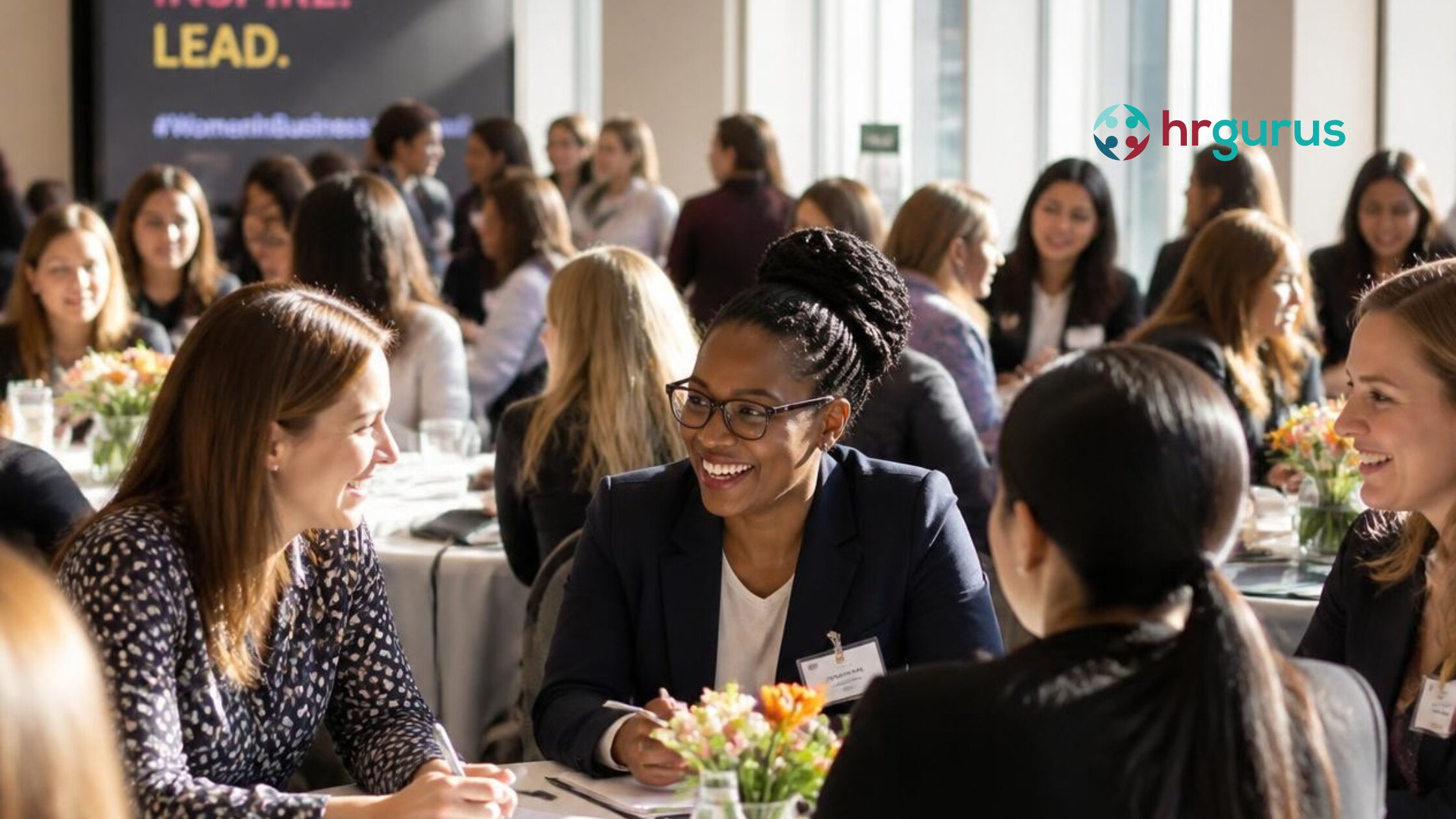
I saw a post from Justine Youl on LinkedIn this week and I haven’t stopped thinking about it.
Justine said she gets invited to more “women in business” events than she can count. Then she asked a question that might get us both in trouble.
If the goal is inclusion, why do we keep creating separate rooms?
I’ve been wondering the same thing for a while.
Women’s lunches. Women’s panels. Women’s think tanks. Women’s breakfasts with a guest speaker and a cute little gift bag. I’ve been to plenty. Some were brilliant. And I still can’t shake the feeling we might be getting part of this wrong.
Justine put it well. She doesn’t want to only network with women. She wants to be where business is happening. The golf day. The corporate box. The lunch where someone says “you two should talk.”
Me too. So I went digging.
Where do business decisions actually get made?
Not at the women’s lunch. Mostly.
Deals and referrals happen through relationships, and a lot of those relationships are built on the golf course, in the corporate box at the footy and over Friday drinks. That’s not a hunch. In a 2002 Starwood Hotels survey, 43% of executives said some of their biggest deals were done on a golf course. A year later, a Catalyst survey of 705 senior women found more than 40% named exclusion from informal networks as a barrier, with golf one of the most mentioned (Seattle Times). Maybe I should learn how to play golf. LOL.
More recently, research in academic medicine found 73% of women raised the “boys club” without being asked, and both men and women named the golf course as a key place where relationships get built (The Conversation).
So, if the decisions are in that room, what are we doing in this one?
Is a separate room helping us or holding us back?
Some research suggests women-only networks can end up working against the women in them. A University of Edinburgh study found women-only entrepreneur networks tended to get pushed into a niche, rather than opening doors to the networks that actually drive growth (Forbes).
Women aren’t always sold on them either. A 2025 study in the Journal of Management found women at different levels bonded over shared frustration with the enforced feel of some women-only networking events (Hein, Diehl and Kreutzer, 2025).
Closer to home, Australian academic Athena Vongalis-Macrow found 67% of professional women surveyed knew networking mattered, but their networking wasn’t actually getting them where they wanted to go (Atlantic Business).
Lots of networking. Not much getting into the rooms that count.
Why don’t we hear about men-only business events?
Justine asked the obvious question. How often do you hear about a “Men in Business” event?
My first instinct was to say “because they don’t exist”. If someone launched a men-only business lunch tomorrow, the headlines would write themselves.
But that’s not quite true. They exist. They just don’t call themselves events. Sydney’s Australian Club is still men-only, and in 2021 members voted down a proposal to let women join. The Melbourne Club made the same call.
And the informal stuff doesn’t need a label. When the golf day and the footy box are mostly blokes by default, nobody has to write “men only” on the invite.
Which might make the point stronger. The rooms where power sits are already separate. Does building another separate room next door get us into the first one?
Is a women-only event even legal?
HR hat on. In Australia, generally yes.
The Sex Discrimination Act allows “special measures” aimed at substantive equality between men and women. The Federal Court has backed this, finding a women-only gym class wasn’t discriminatory because it was a special measure (AHRC guidelines).
The catch for employers: nobody certifies a special measure for you. If you run a women-only program inside your business, it’s on you to be satisfied it genuinely furthers equality. In the US, the EEOC is suing a Coca-Cola bottler over a women-only networking event (Forbes). That’s a long way from Tassie, but it shows where the conversation is heading.
Why don’t I want to be called a “woman in business”?
I’ll be honest. I don’t love being introduced as a woman in business, like it’s a special category or a bonus round. I’m in business. Full stop.
I’m not alone. One founder turned down a spot on a women-only list and asked how often you hear men called male founders. Another said women-only stories make women’s success look like the exception rather than the norm (TechCabal).
Plenty of women see it the other way. Australian founder Jules Brooke wrote that she’ll happily drop the label once there’s real equality in business, and until then she’s proud to be a female founder (SmartCompany). She has a point. Women make up 35% of Australian business owners (ASBFEO). We’re not there yet.
So, should we stop running women-only events?
This is where it gets interesting, and where I don’t think there’s a clean answer.
A 2019 Kellogg study found the women who landed the most senior roles had two things: a tight inner circle of two or three women, and a central spot in the wider, mixed network. Women with both had an expected job placement level 2.5 times higher than women with neither. For men, the gender mix of their network made no difference (Kellogg Insight).
So, the women’s circle matters. A lot. But it was the combination that won, not the circle on its own.
Maybe that’s the real question. Not “should women-only events exist?” but “are we treating them as the whole inclusion strategy, when they’re only half of it?”
And to be fair to the other side, many women say these events are where they feel safe, get honest advice and can actually attend around school pick-up or a newborn (Creative Review). That counts for something.
What do you think?
I genuinely want to hear this one argued out. Justine started it on LinkedIn, so let’s keep it going.
Are women-only business events building us up, or building us a nicer room off to the side? Would you choose a mixed event over a women’s one? And if you run a business, are you making sure the women in your team get into the rooms where decisions really happen?
Tell me I’m wrong. Tell me I’m right. Either way, let’s cut through the BS and have the conversation properly.
FAQ
Are women-only business events legal in Australia?
Generally, yes. The Sex Discrimination Act allows special measures aimed at achieving substantive equality between men and women. The organiser needs to be satisfied the event genuinely furthers that purpose, as no one certifies it for you.
Can an employer run a women-only program for staff?
Usually, if it’s a genuine special measure. Be clear on the purpose, keep a record of why it’s needed, and make sure it reasonably helps close a real gap. If you’re unsure, get advice before you launch it.
Do women-only networks help women’s careers?
The evidence is mixed. Kellogg research found women do best with a close circle of other women plus a central place in the wider, mixed network. Other research suggests women-only networks can push women into a niche if that’s all they rely on.
Do men-only business clubs still exist in Australia?
Yes. Sydney’s Australian Club and the Melbourne Club both still restrict membership to men. Plenty of informal networks, like golf days and corporate boxes, are male-dominated without any formal rule.
Why do some women dislike the “woman in business” label?
Some feel it frames them as a special category rather than simply business owners. Others embrace it for visibility, role modelling and access to funding aimed at women-led businesses.
Sources
- Justine Youl, LinkedIn post on women in business events (2026)
- Yang, Chawla and Uzzi (2019), PNAS, and Kellogg Insight summary
- Hein, Diehl and Kreutzer (2025), Journal of Management
- Forbes: Edinburgh research on women-only networks (2020)
- Forbes: Coca-Cola bottler sued over women-only event (2026)
- Seattle Times: Starwood 2002 and Catalyst 2003 figures
- The Conversation: networking in academic medicine
- Atlantic Business: Vongalis-Macrow research
- Australian Club (Wikipedia) and Women’s Agenda: Melbourne Club vote
- AHRC: Special measures guidelines (2018)
- ASBFEO: Small Business Matters (June 2023)
- TechCabal: drop the female founder title
- SmartCompany: Jules Brooke
- Creative Review: why is women-only networking still a thing?



Get a personal consultation.
Call us today at 1300 959 560.
Here in HR Gurus. We make HR simple because it should be.